The Ultimate First Timer’s Guide to Playing the Sunday Million
Stop dreaming about the Sunday Million. Start playing it.

Table of Contents
This post was originally published on 20 March 2020 and updated in April 2024.
Are you one of those poker players who has always wanted to play the Sunday Million, but hasn’t?
Someone who intends one day to step up in their game, but has no real plan for how to go about it?
If you are, this Ultimate Guide to playing the Sunday Million is for you.
It’s for anyone who wants to play the Sunday Million for the first time, but for whatever reason has yet to take that step.
Whether it’s because you don’t think you have the experience… or the timing just isn’t quite right… or your bankroll doesn’t stretch that far.
Those things sound pretty persuasive when they echo in our heads.
But while you might not think it right this second, the timing actually IS right. Your experience IS enough.
And your bankroll?
We’re about to show you why you don’t really need much of that.
What we ARE talking about is transforming you from the player you are now into the player you’ve always wanted to be.

And the timing couldn’t be better.
Here’s why…
The timing is perfect to play the Sunday Million for the first time
For a start you’d be playing the Sunday Million, not reading about it on Monday morning.
That would make you one of those players who operates from the middle of the poker world — not just in its orbit.
And yes, you might be a little more tired on a Monday morning. But feeling a little less energetic never felt so satisfying.
And let’s be clear for a second. We know it’s not simple. There’s effort involved.
But that’s what we can help with.
This guide makes that process as easy as possible.

The Sunday Million is the highlight of the online poker week. Held on PokerStars every Sunday with a guaranteed prize pool of $1 million
A Sunday Million like no other
It’s usually the biggest event of the week on PokerStars, with a $1 million guarantee — many more times that on it’s Anniversary. That’s life-changing money to the top finishers, and life-enhancing money for many others.
That makes it the event everyone wants to play.
And yet so many still don’t, held back for reasons that we will dismantle one by one in this guide.
Maybe it’s confidence, experience, or just feeling out of place. In this guide to playing Sunday Million we’ll show you how each of those can be overcome.
We’ll show you why not only are those fears misplaced, but how you can bypass all of them, take a seat, and play your best on the biggest weekly poker stage there is.
Even if your bankroll rattles rather than flutters.
Even if your playing time is based around family and work.
Even if your ambition says yes, but your confidence says no.
It’s time to become the player you always wanted to be. Read on to get started.
Your first Sunday Million is a challenge worth taking on
The Sunday Million can seem like a big obstacle. No other event is talked about and written about every week.
Then there’s the money involved.
The more zeros in a prize pool the more experience you need, right?
But then think about it – how many obstacles worth scaling do you know that have ever been described as “small”?
The space programme didn’t aim to put a man on top of the world’s tallest building.
Hillary and Tenzing did not set out from base camp to get as far as they could up Everest before it got a bit too chilly and they turned back.
Your aim is simply to play the Sunday Million for the first time.
Luckily it’s not as hard as reaching the moon, or the top of Everest. Even though it might feel like that sometimes.
How to get past old obstacles
So it’s easy to put off. Maybe next week, or next month, or next year.
And that’s fine if you’re not fully committed to that next step. Test yourself next time perhaps. Let this opportunity slip by.
Of course, if you’ve read this far you’re not thinking that.
You want a way in, and the obstacles between you and a seat are real.
They’re not insignificant. They’re very real.
That’s why we’re going to help you get past them.
Poker’s Rite of Passage
Because something happens when you play the Sunday Million. You’re taken out of rookie status, and into a new way of thinking.
Call it poker’s rite of passage.
You’re sent off into an unfamiliar environment, but return better, more knowledgeable, less afraid, and ready to try again.
How to dismantle the things that used to stop you
What you’ll find here is the complete and ultimate myth-busting guide to playing the Sunday Million this weekend – and every Sunday Million beyond that.
The guide to playing Sunday Million is made up of FIVE easy-to-follow chapters below.
Each teaches you how to survive a particular scenario – one that’s likely to have put you off playing in the past.
You can pick and choose which chapters to read if you prefer. The links below will take you where you want to go. Or you can read them in order one by one.
Here’s what you’ll learn along the way.
In PART #1 you’ll learn how to avoid busting before you even take a seat. In other words, how to successful win a seat to the Sunday Million for free using Power Path, or in a satellite for a dollar or two.
In PART #2 we get to the nitty-gritty of how to play against those aggressive players who you dread, and who so often ruin your tournament. It will arm you with everything you need to spot them, adjust and even turn the tables on them.
In PART #3 we take “luck” out of the equation. We outline what strategies you can use when you’re card dead and in need of a hand.
PART #4 talks money. How to reach it rather than crashing out before the bubble.
And in the final PART #5 we arm you with the knowledge you need to take on more experienced players, as you go deeper into the business end of the tournament.
By the end, you’ll not only see how those mountains you put in your way were actually molehills, but you’ll be eager to put what you’ve learned into practice.
Start being the player you want to be
It’s natural to size up a poker game in terms of how likely you are to do well.
The lessons you’ll learn here are designed to help you see past the obstacles you previously believed to be too high to overcome.
And, to play the tournaments you’ve always wanted to play, but were too afraid to try.
This guide will demonstrate that there’s nothing stopping you.
Perhaps you don’t think the time is right to play the Sunday million for the first time. That’s understandable. It takes courage to do things like this – even to take a step closer to the player you want to become.
But becoming the player you want to be – -the version of you that is most capable when dealt two cards in a game of hold’em – takes action.
And you can take that first action in Part #1…
PART #1: How to pick the best satellite to win a Sunday Million seat
Like most poker players you want to play the Sunday Million. But right now, your bankroll doesn’t stretch to the full buy-in.
What would be great is a way to play the Sunday Million, without playing the full price.
Put another way, how do you play this must-play event, for a fraction of the $109 entry fee?
Well in this article we’re going to explain exactly how to do that.
Because while most players buy-in directly to the Sunday Million, roughly ten per cent win their way in playing satellites of some sort.
And in a tournament that regularly has a field tens of thousands strong, that’s a lot of satellite seats.
Here’s how to join them.
Start with Power Path
The first version of this guide didn’t include anything about Power Path. Quite simply it hadn’t been invented yet.
But flash forward to now and it ranks as perhaps the best way any new or recreational player can play the Sunday Million (along with a host of other events live and online).

Power Path gives you the opportunity to win your seat to the Sunday Million (and other online and live PokerStars events) for free. Earn a Power Path ticket EVERY DAY simply by playing a real money game in PokerStars.
We have a complete introduction to Power Path which you can read here. That will get you up to speed on the four steps involved, and how you can turn a free ticket (awarded every day to anyone who plays a single hand of real money poker).
But here’s the short explanation that saves you a click.
How Power Path works
It starts with a $0.50 Spin & Go that you can buy in to directly, or enter using a Step 1 ticket. Remember you receive one of those every day you play a real-money game.
But wait. There’s more to it than first glance.

The four steps of Power Path. Start for free and win a Bronze, Silver or Gold Pass that could gain you entry into major online and live PokerStars events.
Like regular Spin & Go’s, the Step 1 Spin & Go’s has prizes on offer that are not limited to a ticket into Step 2.
You could win anything from a Gold Power Pass, a Silver Power Pass, or Bronze Power Pass. That’s just by playing a Step 1 Spin & Go.
The most common prizes, however, will be entry to Step 2. That puts you a step closer to the Sunday Million.
And at this point things can go one of two ways.
You can play either a $1 Sit & Go (16 players). Or you can go for a $1.50 MTTs.
Both can be entered by using tickets won in Step 1. Or by buying in directly.
Both offer entry into Step 3.
Nearly there.
You’re now at the $11 MTT Step 3 stage. This is the final stage players can buy-in directly. the only way through to Step 4 (think BIG prizes) is via Step 3. offer – you must have won a ticket in a Step 3 event.
It’s at Step 4 that players can win a Bronze, Silver or Gold Power Pass worth the following:
- BRONZE POWER PASS – $109
- SILVER POWER PASS – $2,500
- GOLD POWER PASS -$10,300
How does this connect to the Sunday Million?
Well your eagle eyes will have spotted how the value of a Bronze Pass just happens to match that of a Sunday Million entry. That’s how.
And all for free, provided you played a hand of real money poker. To give you the super short version: there is no better way to win your seat to the Sunday Million.
And if you’re curious about those Silver and Gold Passes (and by the end of this guide you should be), check out this article.
Alternatively, start with the right satellite
Every week, in almost every tournament, satellite tournaments award seats into big events. The type that the players in them couldn’t typically afford to play.
Which means as far as your concerned they’re the perfect. They’re your way into playing.
So here you’re going to learn about strategy. That’s how to pick a Sunday Million satellites, but also how to play them well. And that latter part applies for Power Path players as well.
Even better, in some satellites you don’t need to win the entire thing, just finish in the top spots. We’ll go through that too.
And even better than that… the strategy that’s explained here will help you when you make the jump up to the Sunday Million itself. And in any other tournaments you like to play.
The two step solution to getting it right
And you can get this following two simple steps.
First, it’s about finding the right satellite to suit you. There are lots of them, in various shapes and sizes. It makes sense to play the ones you have an edge in.
Then we’ll take you through the different stages of a satellite. The early stages, middle and then late stages.
Remember, in some satellites it’s not about winning the whole thing. But this guide will get you where you need to be.
How to get started
So first you need to find, and then choose the satellites available. That’s what we’ll go through first.
Remember, the Sunday Million is the biggest event of the week on PokerStars, with satellites running throughout the week.
Start by logging into the PokerStars client (if you don’t already have one, you can download the software here. It’s completely safe, and only takes a matter of minutes).
Click on the Tournaments Tab, and then Sunday Million. Alternatively, just type “Sunday Million” into the search box.
You can sort by date, but you should see the Sunday Million listed. Open the lobby of this event by clicking on it.
At the bottom you’ll see a list of satellites in date order, with the buy-in shown as well as how many tickets are available to win.
So, in the example above you’ll notice $1.10 buy-in satellites with 5 tickets guaranteed.
Think about that for a second. It means you could win a seat worth $109 for a little more than a dollar.
If you scroll through you’ll also see $11 satellites with 50 seats available.
So there’s a choice of “winner takes all” for a small entry fee, or the top 50 finish with a seat for slightly more.
You can sort these by date, buy-in, prize pool, and other categories to help you sort them into an order you want.
Clicking on the Go to Satellites button will take you to the full list, where you can find the satellite you want to play.
Once you’ve done that, you’ll want to study what sort of strategy will suit you best…
This is where PokerStars Learn becomes an invaluable resource.
You’ll find hundreds of training articles to suit every scenario. But here we’ll go through satellite strategy with the aim of getting a Sunday Million seat.
Remember, the best way to improve your chances of qualifying is to pick a satellite that suits your strengths.
So, for example, if you play lots of Sit and Go’s, then you might prefer a one table satellite. And if you’re a Multi-Table Tournament (MTT) player, obviously that should be where you start.
And don’t forget the structure itself. Turbos suit some players, but not others.
So, consider what would be the ideal satellite for you.
But let’s get started on the assumption you’re playing an MTT.
The Early Stages
The early stages are about accumulating chips, but also getting reads on players.
If you’re new to the game, or think you lack skills on this, you can read how to take better poker notes here. But try this to immediately ramp up your reading skills whenever anyone shows their hand…
- Pay attention to what hands players at your table are entering a pot with
- What hands did they limp with?
- What hands did they raise with, or call a raise with?
This doesn’t require math skill or any secret tricks. It’s just about paying attention.
And if you can’t memorize everything you see (you’re not alone!) then make notes as you go.
Here’s an example of that from PokerStars Learn:
“When you see a player limp in from early position, call a raise from a late position player, check/call down on a board of KT673 and then show 65o, it only requires this sample size of this one hand to know they are a very loose/passive calling station.
“Checkmark, now we know how to exploit them… we will value bet them more often and larger when we have the goods, and not try to bluff them when we don’t.”
Again, there’s nothing complicated here. Nothing that requires years of experience. Paying attention pays off even if you’ve only been playing poker a short time. That’s completely in your power.
What’s more, it’s a good habit to get into. It’ll help you get to the next phase of the satellite, which we talk about next…
The Middle Stages
If you’ve followed the steps above, you should have some basic notes on the players you’re directly up against.
This will also have identified which players to look out for, and which to try to play against.
So, let’s look at some quick examples…
- Try 3-betting more often against opponents that open with weaker hands.
- Doing so puts pressure on them to defend their hand, which can be a bad decision when out of position.
From PokerStars Learn…
“If you’ve seen someone open 97s from under-the-gun, they are way too wide to defend vs. your 3-bets adequately.”
By paying attention to how your opponents are playing, and applying that to your own game, you increase the chances of amassing more chips.
The field will be thinning down by now. The looser players will have departed. The shorter stacks will be going too.
The players who do well at this point are the selective aggressive players. That’s what you’re going to be at this point.
Using your notes your plan is to steadily amass chips. That’s what this middle stage is about — getting the chips you need to move into the latter stages.
And that’s what we’re going to talk about next…
The Later Stages
Getting this far is a significant achievement.
You can’t predict what will happen in poker. But if you’ve kept notes and used them well, using the guidance in this article, you’ll have put yourself in a great position to go that next step.
Here we’re going to help you take that final step.
And that goes for whether you reach this end game with a big stack, a short stack, or if you have something in between.
And remember, your strategy now depends on the type of satellite you’re playing.
That will vary significantly if there’s one seat available to the winner, or it’s a 50 seat super-satellite.
So, let’s start with the best case scenario…
Big Stack
This is the dream scenario – a big stack in a super satellite, with the bubble fast approaching.
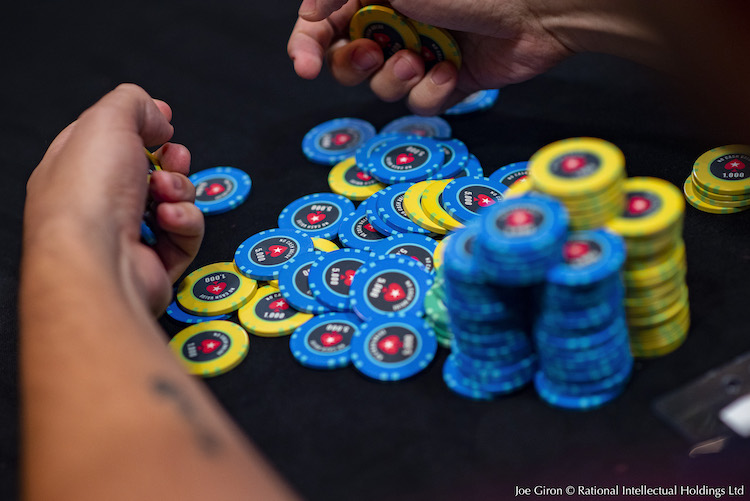
Everyone wants to play with a big stack, but not everyone knows how to use it when they get one. Don’t be that player.
You’re practically guaranteed to win a seat at this stage, provided you avoid certain nightmare scenarios. So, here’s what you should and shouldn’t do:
- You SHOULD min-raise pre-flop into players with medium stacks using any two cards. You’ll pick up the blinds and antes. If they move all in, you can just fold (but they’re likely to fold a lot of hands).
- You SHOULD call any all-ins from the short stacks. They won’t risk your position as one of the big stacks, and you want to try to knock them out.
- You SHOULDN’T get involved with any confrontation with another big stack. This is really the only threat to you at this point.
So, provided you don’t get into any unnecessary scraps with other big stacks, you should be fine. A seat will be yours!
But that’s the ideal scenario. What about the opposite of that, a short stack?
Let’s examine that next…
Short Stack
The poker world looks very different from the point of view of a short stack.
But that doesn’t mean you can’t take advantage and turn that world around!
That’s what the aim is here.
So, what can you expect?
The same applies to a short stack. It’s touch, no doubt about it, but it also gives you opportunity to be aggressive
Well, most players will be waiting for you to bust. They won’t be getting involved in any hands unnecessarily.
What does that mean for you?
Well, it means you don’t need to be afraid to be aggressive, especially when you’re short, but not perilously short stacked.
You can judge this based on your stack size.
Here’s an example to illustrate this…
“If it folds to you on the button and you have a 7 big blind stack, a shove will get through the blinds at a high frequency if your opponents are sitting on 13 and 12 big blinds respectively. They have stacks that can afford to wait out shorter stacks at the bubble.
“If they call you and lose, THEY become the short stack.
“If we are shoving our 7 big blind stacks into a 58 big blind stack, they can obviously call more liberally to try and bust us because the damage to their stack doesn’t jeopardize their position should they lose.”
So, it’s about judging your own stack alongside your opponents. Avoid the big ones, take advantage of those worried about swapping places with you.
There’s one more scenario to examine, which we’ll get to next…
Medium Stack
In some ways this is the harder of the three scenarios.
The world is quite simple as a big stack or a short stack. With a medium stack though, you have a bit of a tightrope to walk.
But that’s what we’re going to go through here.
Like in the other scenarios, you need to be aware of your own position in relation to the other stacks at your table.
Start with how many super-short stacks are there?
This is where patience is a virtue. If you can wait them out, then that’s a wise strategy.
But you can’t always depend on that being the case. So instead, look out for these two scenarios:
First, a premium hand. The ideal scenario always helps. You can play knowing you’re in a strong position.
But those premium hands have a habit of disappearing when you need them most.
So, what else can you do?
Well, you can pick out the other medium stacks who are also trying to wait out the shorter ones. Which of these would be critically damaged if they lost a hand against you?
The notes you’ve been keeping will help on this, if you don’t know them already after reaching this far.
These players will have no choice but to fold without a great hand.
That makes a great position to exploit and turn your medium stack into a more stable big one.
Get started right away
If you’re still waiting for the right time to have a go at reaching the Sunday Million, the details above have hopefully shown you that there’s really no reason to keep waiting. Using the right satellites, and the simple guide for each stage of the event outlined here, you can make enormous progress.
And when satellites start at $1.10 (or even less) you can use this strategy repeatedly.
No more watching from the rail. No more missing out. No more reading the results wondering what if. And most importantly of all, no more feeling powerless to turn your game around to become the player you want to be.
You can get started right away by checking out the Sunday Million satellites in the PokerStars Lobby.
And remember, that while the hard work of getting to the Sunday Million has been done, you now must prepare yourself for the event itself, and the type of field you’re up against.
They’re likely be to more experienced, and just as eager to get their hands on your chips.
That’s why we address how to take on these players in CHAPTER 2: HOW TO STOP BEING BULLIED.
—
PART #2: How to play against aggressive players (and make yourself bully-proof!)
There’s nothing worse than that player at your table who relentlessly bullies everyone else, especially you.
These aggro types can turn a fun game into a nightmare. Worst of all they can swiftly bring your own tournament ambitions to a halt.
Either they force you into making a mistake that costs you your stack. Or you freeze up, limiting yourself to a handful of illusive premium hands.
It can be enough to stop you playing events like the Sunday Million.

Felix Schneiders — one of the nicest people in poker – temporarily looking like a maniac to illustrate a point
What if instead of being the victim to this table bullies, you could quickly analyse their playing style, and develop an easy strategy that neutralised their power over you?
Suddenly you would not only survive an encounter with them, you might even benefit.
This part of the guide to playing Sunday Million will show you how to do just that.
It will start by explaining the four different types of bully you’re likely to encounter, before giving you simple, easy to use tips to take each of them on.
You’ll soon realise that rather than them being players to worry about, you’ll find yourself taking them on.
So, let’s get started. Read on to find out more.
The four types of bully
As you’re about to discover, there are four main types of bully to look out for (we mean the poker term, they’re likely lovely people in real life!)
You may even be familiar with the terms:
Smart LAG. Bad LAGs. Maniac, and TAG Bullies.
(A quick reminder. LAG = Loose Aggressive. TAG = Tight Aggressive. Maniac = well, you know).
By spotting the type of player you’re up against, you can remove some of the mystery behind them. What might seem unpredictable will make more sense once you work this out.
Then, using the tips that follow here, you can undo the worst of it.
It’ll take the fear out of your game and give you confidence to make it through the early stages of a tournament.
And posting these different types will gradually become second nature.
There’s something else that you’ll benefit from too.
Once you learn how to defend yourself against these four types of hyper-aggressive players, you’ll uncover how to turn the tables yourself and use the best of what they know in your own game.
But we’ll save that for the next chapter.
For now, you could think of what we’re about to show you as being like a martial art.
A way to use the strength of your opponent against them. Call it poker Judo.
Our plan is to make you a black belt. Let’s start by getting in the ring.
Their characteristics, and how to beat them
There are four types of player to look out for. That sounds like a lot, but it’s not. As you’ll see, we’re going to go through each of them individually and give you the tools to defend yourself.
We start with the characteristics of each kind of player. Then, we arm you with some simple adjustments to make.
There’s nothing complicated about this, and very little guess work. There would be no point teaching you anything that required years of practice, or a super-knowledge of everything poker.
You don’t need any of that. In fact, you’ll likely find these descriptions familiar.
Annoyingly familiar come to think of it.
Smart LAGs
Let’s start with how to identify these Smart, Loose Aggressive players.
- They play a lot of hands, and they play them well post flop too
- They’re only really looking to play a big pot with a big hand
- They’re good enough to change that definition depending on the opponent
- Their aim is to win small pots. Lots of them. And get big value with their big hands.
Let’s be clear. These Smart LAGs are good players. And there’s lots to learn from them. Just watching them as they beat up on another poor soul will turn these descriptions into eye-watering practical demonstrations.

An aggressive player like Deborah Worley-Roberts can easily dominate a table. Being aware of the threat of aggressive players is an important part of navigating past them in the online game
So, here’s how to adjust your game to take them on.
- When they go for their small pot victories, attack them. Check raise the flop more. Call the flop then raise on the turn. They’re looking for easy wins. Push back.
- There’s no reason to look for a fight. So, avoid playing big pots against them without a big hand. Especially when you both have a deep stack.
- If they’re playing small ball poker – playing a wide range of starting hands but with much small bet sizes – try some long ball poker when you get involved.
What does that look like? Here’s an example from PokerStars Learn…
“This means you may look to put in some larger than normal 3-bets pre-flop against their opens, or large bet or raise sizings after the flop to attack them.”
That comes with a warning not to go overboard though. You don’t want to end up in a big pot without a real hand.
“But the idea here is to take away their ability to successfully stab and manoeuvre in smaller pots by applying bigger bets, against ranges that are necessarily weaker than normal because they started wide to begin with.”
In short: flip their aggressive small ball strategy against them.
That helps with Smart LAGs, but what about the opposite type of LAG. The Bad kind. That’s who we’ll deal with next…
Bad LAGs
Again, let’s start by identifying them by their playing style.
- The players will play a lot of hands, but not always well after the flop
- They bluff too much, and go too far with weak hands trying to wear you down by brute force alone
- They don’t adjust well either. They don’t always spot how players are reacting to their own aggression
Sounds familiar doesn’t it?
Well here are some adjustments that will not only lift you out of your misery but put them out of theirs.
- Start by getting a bit more speculative, especially with a deep stack. Sooner or later you’ll hit your hand and get value from theirs.
- Value bet your hands a little harder. That means making them bigger than you normally would. Bad LAGs are less likely to adjust to this and will give you greater value with their poorer hands
- Some hands, like top pair with top kicker, or big over pairs, are worth playing bigger pots with than you would against other types of player.
- And if you do get a monster, you can slow play if the villain figures to be bluffing. Or simply play them fast. Bad LAGs will tend to overplay their made hands and give you action with less convincing values.
The bonus adjustment to make is not to look too smug when their tournament comes to a premature end.
But they might not be the worse type. Because next up are the Maniacs.
Maniacs
You might have guessed this, but these players are easiest to spot. Here’s how to pick them out.
- And endless pattern of bets and raises almost at every opportunity
- Having entered so many hands pre-flop, they are often playing marginal hands post flop.
- Often presses the action with weak hands and total air, the result of bluffing too often
You might not have needed those reminders. But let’s get to how you can make the most from these unpredictable encounters with some simple adjustments.
- Maniacs are looking to attack weakness. So, encourage them to make more of their favourite mistake (bluffing) by showing weakness when your hand has showdown value.
- Call them down lighter. That means becoming a bit more of a calling station. Because think about it: when you’re playing against someone who calls too easily your plan should be to value bet at every opportunity, but to never bluff (they’ll call you). Apply the reverse thought process instead.
- Raise your monster hands on the river if they’re driving the action. Maniacs will bluff more than most. So, give them room to do so as much as possible. There’s one exception though. If they’re super-Maniacs, the type who re-raise with garbage, then get raising with your big hands before the river. You plan should be to get them pot committed as soon as you can.
You’ve survived the Maniacs. Now onto the last type…
TAG Bullies
Of all the aggressive players you’ll encounter, you’re likely to see this one less often than most. But when you do find them, here’s what you can expect.
- They will hardly ever be passive when playing a pot
- They use “push” tactics a lot (never “pull”)
- They’re tougher to adjust to. They tend to play a stronger range so will be bluffing at a more reasonable frequency to their legitimate value bets
But like others there are adjustments you can make to deal with this.
- Start by bluffing or semi-bluffing when it’s appropriate. If TAG bullies have weaknesses, it’s that they’re susceptible to bluffs on board that look good for your range (and bad for theirs).
- Good non-monster hands usually do better keeping the TAG bully’s range wide. In conjunction with the point above, raising or re-raising them will narrow their range to stronger hands and draws, which isn’t necessarily desirable when we have a good but not great made hand.
- Lastly, there’s nothing wrong with some good old fashioned avoidance. TAG bullies are a tough opponent to adjust too – tougher than the other types we’ve listed here. Thankfully you won’t see them as often.
Stop feeling intimidated, start playing
So, we’ve identified the four different types of aggressive player who you will inevitably run into an any tournament.
But we’ve also outlined how to identify them, as well as how to adjust to their style of play – and maybe even turn the tables a little bit.
If you stop seeing them as there to ruin your chances, and instead as player you’re well equipped to take on, your confidence will improve, as will your chances of progressing well.
You won’t win every time. But you’ll start to feel less intimidated.
You’ll also start to see how your tournament chances are not down to luck but are in your own hands. Which is what we talk about in the next part of this guide…
—
PART #3: How to change your luck (or how to play when card dead)
It’s an agonising experience. Hand after hand comes along, but not even a glimpse of a hand worth playing.
Slowly, but steadily your stack dwindles away as you find yourself desperate for any two cards you can make a go of.
It’s not only excruciating, but this endless run of bad luck and bad cards can make you feel like the world has turned against you.

The game can sometimes feel like it’s all going against you. But the best players know it’s more about what you can control. Especially when card dead.
But what if instead of sitting there powerless to do anything about it you were able to change the situation?
What if, using a couple of simple techniques, you could not only stop this run of bad luck, but also make the cards you were dealt almost irrelevant.
What would almost mean an end to bad luck full stop!
Well in this chapter of our guide to playing Sunday Million we’re going to tell you how to do exactly that.
We’ll show you how to put that mantra of bad luck behind you and become the kind of player who is oblivious to such excuses.
We’ll show you what you can do to change your fate.
Even if you’ve been card dead all tournament. And even if your stack is dwindling to perilous levels. And even if you see no way out of your terminal freefall.
Keep reading to find out how to end this bad luck for good.
Put an end to bad luck
So how do we end that feeling of having been cursed by a run of bad cards?
How do we make sure that even when we stop getting those good looking hands we can play well, keep accumulating chips, and get deeper into a tournament?
We’re going to go through that process here.
And it’s worth pointing out that each of the four tips that follow require no experience. It’s also the kind of thing you can do in any tournament.
You’ll be able to use these skills again and again. You’ll find yourself talking less about being card dead. Less about luck. You’ll even listen to those players who do and know their chips are yours for the taking.
Which has to be better than being “that player” who pops up in every game.
You know who we mean. The player who would be the self-professed best in the world were it not for their epic run of bad cards.
The three steps that make you stronger
We’re going to outline three simple steps that will turn your game around.
The first step is about staying disciplined. We’re not talking about laser focus. It’s as simple as paying attention.
The second step is to think situations, not hands, and is arguably the most powerful way you can level up your game right now.
And the final step involves knowing your push and fold ranges. And that’s not about memorising complicated numbers. It’s much easier than that, and we’ll show you how.
All of this puts you in a much stronger position to go deeper into a tournament when you’re card dead. It’ll also make you a better player in general.
One who is in control of their game, not one who is being controlled by the game.
Read on to get started…
Stay disciplined and pay attention
Before you start thinking of physical exercise and memorising everything that happens on the table, let’s rewind just a second.
There’s none of that.
You can try to memorise everything you see, but you’re going to start forgetting things pretty fast!
There’s a much easier way to think about this.
Because what we want to do here is stop you from becoming one of those players who blames their demise on the cards.
As Dave Roemer writes on PokerStars Learn: the person who makes excuses like “that was the best hand I’ve seen in two hours”.
Let’s remember this is poker. It doesn’t always go how we want to it.
But what that guy doesn’t know is that he actually had more control over his fate than he thought.
That’s what we’re talking about here.
So what does staying disciplined mean?
Simple.
It means not getting distracted by those worse-than-mediocre hands that, in the middle of a drought, look stronger than they actually are.
You know the kind.
Jack-nine anyone?
Queen-eight?
Just because there’s a face looking back at you for the first time in a while, it doesn’t mean you should think action.
Don’t be tempted to try something just because it’s the first picture card you’ve seen in a while. Let the other guy waste chips playing weak hands.
How to pay attention
You can also be confident that the player who complains isn’t paying attention.
But that’s what you can do. It’s such a simple and easy way to pick up information.
Start by observing others. And remember the notes you started making earlier on (if you need a recap on that point you can go back to Part #1. Or get a deeper recap on note-taking by clicking here).
But you might be thinking that note-taking is all well and good, but it’s no good if you don’t know what you’re looking for.
Let’s fix that.
Start by seeing who’s folding.
Everyone folds the terrible hands. But others will fold better hands – the type they really ought to be defending.
So keep track. Who is who? You know why you’re having to fold, but why are they?
This will also help you use the new bullying skills you learned in Part #2. You’ll know who is weak, and how to attack them.
But there’s an even more useful trick you can do. It’s your first step towards developing poker super powers.

Folding is a big part of the game. But as the old saying goes, you need to know when to fold.
How to think situations not hands
If there’s a skill you can develop that will eliminate the need to complain about bad luck and being card dead, this is it.
This is the super power that allows you to think differently.
You’re no longer trapped by bad cards.
Because if you only play the cards you’re given, you’ll always think you’re card dead.
Again, as Dave Roemer writes:
Players who chronically complain about being card dead typically come back to this mantra over and over because they are just playing their cards.
But this is where you change that.
And if you’ve followed the advice earlier about staying disciplined, and paying attention, you’ve already made a great start.
So how do you take your game to the next level?
Let’s take an extreme example first.
Let’s say the action folds to you in the small blind, and the big blind player is sitting out.
This is a situation where you would raise regardless of your holding.
And to be clear, your actual hand is a part of this equation… if you are dealt aces, that’s a good situation regardless of all other factors.
But back to the example of the big blind sitter…
What if they weren’t sitting out? What if they were just a very tight, conservative player?
Would you need a top-tier hand to attack this player?
How about if you’d observed the player on your right opening frequently with a wide range of hands, but folding to 3-bets when someone re-raises?
You get the idea.
Often the most basic information can give you an enormous edge. The type you can benefit from almost without looking at your cards.
So remember.
Your notes are invaluable for this. Stay disciplined, pay attention, and use that information. It’s free. And it will never be worth as much as when you’re just not getting cards.
There’s one other habit to develop too. That’s what we’ll talk about next.
Know your push/fold ranges
Let’s face it, everyone gets short-stacked eventually. Sooner or later that will include you.
But you’re not going to bust with a whimper.
When it happens it’ll be on your terms, and with gusto. That’s what we’re going to talk about here.
Because while you don’t need to commit specific hands to memory, having an idea of ranges for folding and pushing is going to help you.

At the very least you won’t be like those poor souls who nurse a stack of three big blinds, and then fold yet again on the big blind because – yet again – they didn’t get a good hand.
This looks bad. And, it’s the wrong move.
I watched a friend do this recently, and asked him, what are you doing folding there? He said, “I had T3o, I’m totally card dead”.
Here’s the thing… with a 3 big blind stack and 1.1 of them already in the middle in the form of the ante and big blind, T3o is a profitable call mathematically.
That’s an extreme example. And half the battle of this advice is trusting in it.
It can be hard to put your whole tournament on the line with a terrible hand, just because the mathematics suggests you should do.
But understanding the hands you’re going to push all in with, and which you’re going to fold, gives you a useful strategy. It’s an effective one too. It almost takes the decision-making out of it.
Let the other player blame their cards, not you
Nobody really enjoys being card dead. But nobody wants to be that player who complains all the time either. The one who blames the cards rather than how they play them.
You’re in the game to get better. To win more and develop as a player.
The lessons outlined here get you started with that.
They help you take a big step towards becoming the player you want to be, and ought to be.
Let the other guy blame their cards.
—
CHAPTER #4: How to start making the money (and stop bursting the bubble)
You might be wary of the tournament bubble. After all, there’s no worse a place to be busted from a poker tournament) with the possible exception of heads-up).
All the effort and hard work, especially if you’ve put into practice everything we’ve told you about in this guide, is wasted.

The bubble is where the money comes into play. Busting before the bubble can be devastating, so learning how to maximise your options at this crucial moment will serve you well in the Sunday Million
It may even be what stops you trying the Sunday Million again.
But what if you could learn quick strategies that, when the time comes, will help you navigate the tricky waters around the bubble, and put yourself in a better position to face that other bubble – the final table.
That’s what this article is about.
It’s about getting you past what is almost a mental block.
Sure, it’s not always something you can control. But that shouldn’t stop you doing everything you can to get through it, and keep using those same simple strategies for every pay jump, all the way to the final table.
Read this section of our guide to playing Sunday Million to learn ways you can increase your chances of making the money.
There’s more to the bubble than stack size
It might look like a simple equation – you either cash or you don’t.
But there’s more to the bubble than that.
It’s not just about stack sizes (although that’s a big part of it).
It’s also about the types of players at your table, and how they are most likely to play at this crucial stage.
That’s what we’re going to break down in this article.
Not just the types of players, but how they are likely to play.
Even better, we’ll show you how to identify these players using a simple trick, which allow you to take a better, more profitable approach to playing them.
The three types of player to look out for
There are three main types of player to look out for.
First we’ll go through the characteristics of each kind of player when they’re on the bubble.
Then, we’ll get to the all important system of working out who is who (it’s super easy and requires no special knowledge, or anything like that)
Then we’ll jump ahead to the bubble AFTER the bubble, when you’re looking at a spot on the previously elusive final table.
Let’s get started.
How to spot which is which
Knowing the types of players at your table not only helps predict how they will approach the bubble it also means you can adjust your strategy to make the most of it.
And working this out is easier than you think.
There are three main category of players.
- Professional or solid winning players
- Casual or fun players
- Micro stakes players
Each has a different motivation, and will play differently when the money is in sight.
Let’s take a look at each.
Professional or solid player
As you’d expect, these players are looking to play optimum strategy.
That means if they’re short stacked, they understand the implications of a stack of say three big blinds. Even if they move all in and double up they’re still in critical condition.
So the best ICM strategy (clicking that link will take you to a really easy example of what that means) is to play ultra-tight. They want to make the money just like everyone else.
However, give these players a big stack and they’re likely to use it to exploit the smaller ones desperate to min cash.
Casual or Fun player
For players like this, and you might put yourself in this category, cashing means more than just making the money.
It’s about achieving something. It might be your first chance to cash in an event this size, and that’s not to be sniffed at.
Cashing the Sunday Million sounds even better than Playing the Sunday Million around the water cooler on Monday.
But because it’s so important, playing for their entire stack is unlikely.
Micro stakes player
Maybe you’re in this category.
If you are this will be a big moment for you.
You’d also be forgiven for avoiding any risk at all given the enormous boost to your bankroll making the money would represent.
It’s a windfall you can’t easily ignore.
But before we get to how you can adjust your own game to take on each of these categories (regardless of which you belong in yourself), you need find out which of these categories fit your opponents.
That’s what we’re gong to talk about next.
How to determine what type of players are at your table
This is where we introduce you to a simple trick that will help you work this out.
Again, there’s nothing complicated about it. In fact, it’s so easy you’ll wonder why you haven’t used it before,
The easiest way to work this out would be to know how much each player bought in for. But there’s another way that gives you a good idea.
You’re going to use the search function in the PokerStars lobby.
From there select TOOLS.
Then select FIND A PLAYER.
Then type in the screen name of the player you want to look up. Next, use the bullet points below to get information:
- If they’re playing three other tables of buy-ins of $5 and lower: Micro stakes player
- If they’re ONLY playing the Sunday Million: Probable Casual/Fun player
- If they’re playing eight tables with buy-ins of $20+: Pro/reg
- And if their search is blocked: Most likely a regular player
A simple way to find out so much.
Do this with other players at the table, and in a few moments you’ll get a rough idea of who you’re up against.
Even better, you can make changes to how play against them.
Making adjustments
Actually, most of this is now logical.

You won’t have to understand how to manage the TV cameras on the Sunday Million bubble. But understanding how play changes at this stage can be a huge advantage
If you’re up against a fellow casual player, or a fellow micro stakes player (and you’ll know this having looked them up) you can apply pressure, knowing they’re most likely to fold as they look for a min-cash.
So if your stack is bigger than theirs get stealing from them.
But a word of warning.
Make sure you’re sensible about this.
Take this example from PokerStars Learn.
Let’s say it folds to us in the small blind.
We have a 15 big blind stack and the big blind has 12 big blinds.
If the BB is a micro stakes player, we can raise small with any two cards and win the blinds and antes often enough to turn an immediate profit.
We don’t need to put 12 big blinds at risk since we expect this player type to overfold to our raise, specifically because of the bubble situation.
So we can simply raise and fold to a shove, knowing it’s probable they have a bonafide monster when they re-raise us.
That will put you in a great position to make the money. But remember, that’s just the first hurdle. You want to go even further than that, to the next bubble if you can. That’s what we’ll go over next.
What about the other bubble?
What you’ve learned getting through the money bubble will help enormously as you try to reach the final table.
But there are some important differences. As outlined on PokerStars Learn.
- Players are no longer faced with “going home empty”. Everyone has secured a significant payout.
- The players left in the tournament will likely be stronger, i.e. more pro/reg heavy.
- Play is shorthanded, with two tables playing down to five players each until the eventual nine handed final table is reached.
And yet the same principles apply but adjusted slightly.
Let’s take the same example as before, where we have 15 big blinds to our opponent’s 12. Only this time they’re a well known regular (and winning) player.
Now a min-raise with our entire range to steal may not work as well as before.
The strong player will move all in with a reasonable number of hands to leverage fold equity on us, something that wasn’t a concern on the money bubble vs. the desperate micro player.
The better play for us is probably to simply raise all-in directly, not with all hands, but with a reasonable ICM type range that can be found on good push/fold charts for a 12 big blind stack.
The strong player will probably call us somewhat correctly. But they’ll still fold more than they should according to ICM call ranges.
They likely perceive an edge over the remaining field, or perceive that we are not actually shoving as wide as we “should” be in this spot.
Plus, they’re human too.
They may not be 100% versed in what the call range should be themselves, folding some of the weaker hands that are correct calls but not intuitive.
No more winging it on the bubble
So let’s recap.
Put simply, there are three different types of players in a tournament, and each is most likely to play a certain way on the bubble.
Using the notes here you now know what those three types are.
And you also know how to use the search system in the PokerStars client to work out what TYPE of player they are. And from there, how they’re likely to play.
That means you’ve also equipped yourself with inside knowledge about them that you can exploit.
That’s regardless of the category of player you fall into.
From there, with sensible play, you can take advantage of shorter stacks, and the types of player at your table.
So no more winging it on the bubble.
No more folding and folding and hoping for the best.
Instead, you can take control of what happens here. You can start making the money, and then going deeper and deeper into tournaments.
And when you get in range of the final table, you can readjust.
—
CHAPTER #5: How to be successful in the Sunday Million, using tips from the pros
It remains one of the most familiar reasons not to play the Sunday Million. How can you possibly be expected to compete against players more experienced that you?
There’s no point getting into the Sunday Million in a satellite, only to be left wondering what to do when you get there.
It’s hoped if you’ve got this far through the Ultimate Guide to playing Sunday Million you’ll have realised there are simple strategies you can use to over come that.
But there’s always room for some additional help.
Because taking on these more experienced players is going to be crucial. Without taking them on you’re destined to bust early, or even worse – with the money in sight.
So what you need are strategies to overcome that.
You need the insider tips that tell you what you need to know, and when to use it.
Which is exactly what this final chapter of our guide to playing the Sunday Million is all about.
So if you want to know how the pros approach an event like the Sunday Million. And if you’re ready to get past those obstacles that have been insurmountable to you in the past, read on.
How to feel more at home in the Sunday Million
This section should leave you with is a sense that you can handle the fluctuating fortunes of an event like the Sunday Million.
Remember, it’s a big event for a reason.
It has thousands of players.
It has more than a million dollars in the prize pool.
In short, it’s the event every poker player wants to play.
You can’t avoid taking on players who technically at least are better than you are, have more experience, and aren’t in the biggest game they’ve ever played.
What you’ll find here are strategies to get past that.
Tips to help you find a home in the Sunday Million, even if it doesn’t go perfectly first time.
But if it doesn’t, their skills and lessons that will make you unrecognisable from the player who started reading this guide back in Part #1.
You’ll be a more confident player, and a better one too.
So let’s get started.
Four things that will help you stick around
There are four steps to go through.
In step one we’ll talk about a pre-flop strategy that’s vital to helping you play more hands that you can win.
In step two we’ll talk about what NOT to do to save leaking chips.
And in step three it’s about value betting (as much as possible)
We’ll then show you how paying attention to the stacks behind you can stop costing you big time.
When you do this you’ll not only learn useful strategy that will help you whenever you play. You’ll in crease you chances of still being around when the big pay outs start.
Let’s get to it.
STEP 1: Three bet pre-flop more
The aim here is to get heads up in a hand with whoever opened the betting, keeping others from getting involved.
Especially when you’re in position.
This shifts things in your favour more.
Not only are you in the best position, but you’re putting your opponent on the defensive.
Think about it. How do you feel when you open the betting only for someone in later position to raise?
So avoid being in this position, but pay attention to putting others under pressure.
Let’s look at what else you need to be wary of…
STEP 2: Don’t leak chips with bad continuation bets
You might think that when you lead the betting pre-flop you need to press on after the flop too.
This can lead to trouble.
Instead, cut out the c-bets when you’ve missed the flop and your fold equity is low.
Ace-king always looks great pre-flop. But on a board like Jack-Nine-Seven, and with several other players in the hand, it doesn’t look so good anymore.
So remember, don’t waste your chips just because you took the role of the aggressor early on. Keep your pride in check and save your chips.
You’ll need them for this next part.
STEP 3: Value bet relentlessly
To understand what is mean by this, put yourself in this simple – and familiar — psychological situation.
You’re facing a bet on the river with a reasonable hand. You don’t want to fold because you think you might have won. So you call, only to see yourself beaten.
Now put yourself in the position of the paying making that bet. That’s the position you want to be in.
That’s what this part is all about.
You want to be the player tempting your opponent to call, when you suspect you’re beating them.
So your mission is to do this more.
Here’s an example from PokerStars Learn of what this might look like.
You open raise in late position with pocket jacks to a little more than two big blinds. The player in the big blind calls.
The flop comes Six-Four-Three rainbow.
After your opponent checks, you continuation bet for 2.5 big blinds (half the pot). They call again.
The turn card pairs the Three and your opponent check/call another half pot value bet of five big blinds. That puts 20 big blinds in the pot.
They check one last time when a Queen lands on the river.
This is a clear value bet and one that players miss again and again.
The opponent has check/called twice already post flop, which means they have something.
Yes, once in a rare while they smashed the board and slow played you all the way… but most of the time they will have a one pair hand or a draw.
Unless they are playing Q4, Q5, or Q6, you still have the best hand. Go ahead and fire!
And here’s why:
Players don’t want to let you bluff them off their A6 or 77 type hands. As a result, you will likely get called by any pair here.
If you bet half pot again, that’s TEN extra big blinds you’re earning on the river that lesser players are not. And all because they are afraid of the queen river or are overly worried they’re being trapped
Those extra 10 big blinds are like an extra tournament life.
There’s’ one more thing you can do too.
STEP 4: Pay attention to player stacks behind you
It’s a simple mistake to make, but not paying attention to the stack sizes of players still to act can cost you big time.
Here’s an example from PokerStars Learn. It usually comes in the form of someone asking whether they were right to call a shove.
They have opened in late position with J9s for three times the big blind with a 22 big blind stack. The player behind them moves all in for 11 big blinds.
They are now priced into calling, making folding feel unattractive.
But they’ll be putting half their stack and all their stack utility at risk while certainly behind the shover’s range, which makes calling unattractive.
Had they been paying attention to the stacks behind them, they may have chosen to not open this hand at all.
Or they might at least have opened for a min-raise to make folding a bit more palatable should the 11 big blind stack shove over the top.
So the key thing to remember here is that if there are tough stacks behind you, like in this example above, then be cautious. But, if you spot an opening, be sure to take advantage.
Ready to strengthen your game and step up?
It’s natural to size up a poker game in terms of how likely you are to do well. Part of that means assessing the quality of the opposition.
But you can also learn ways to strengthen your game in a way that makes you more resilient in the face of a tough field.
Crucially, it separates you from the type of player making these mistakes because they’re just happy to be playing the Sunday Million.
Instead, you can be more aggressive pre-flop, making others weary of you (rather than the other way around).
You can stop carelessly leaking chips with bad continuation bets.
And you can start value betting relentlessly, making the most of every opportunity.
Back to Top






View Other Blogs