Modern tech and human experience at forefront of game integrity
Inside PokerStars: In the second interview of our new series, PokerStars speaks to Head of Game Integrity, Francis Lincoln
For all the fast-paced technological change and arms-race nature of staying a step ahead of those that want to cheat the system – and other players too – there’s something reassuringly grounded and old-school about how PokerStars maintains the integrity of its games, and ensures players have the safest possible space in which to play.
Francis Lincoln, Head of Game Integrity at PokerStars, is in no doubt as to the reason why PokerStars can proudly wear the badge of integrity with absolute confidence.
“I believe it is fair to say it is widely known that PokerStars is the best in the industry when it comes to Game Integrity,” he claims. “We’re held to the highest standard in the industry and lead the way in this area. This is due to years, or really decades, of investment in the team and our tools.”
Brainpower
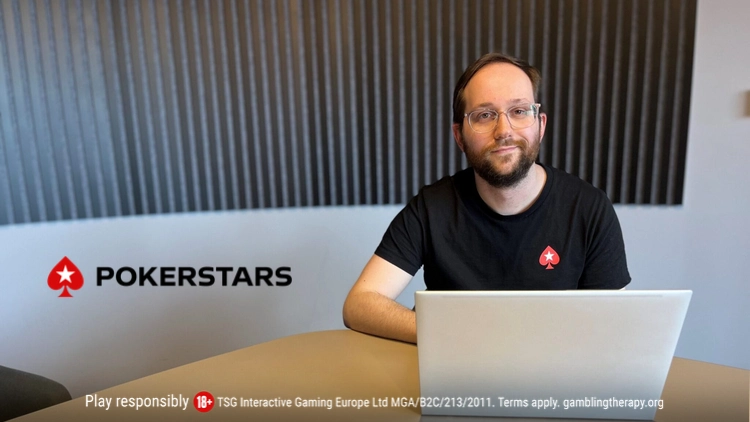
We’re speaking at the Flutter offices (PokerStars’ parent company) in Dublin on a mild Wednesday afternoon in Spring. Lincoln arrives adorned in a classic black PokerStars t-shirt with a laptop under his arm, which he quickly opens. On the screen is an Excel sheet of names.
It is fair to say it is widely known that PokerStars is the best in the industry when it comes to Game Integrity
“We’re currently around 45 staff alongside 10 dedicated Game Integrity developers and our own product team”, Lincoln says, as he points to the laptop screen. “That’s a pretty big machine and a lot of brain power.”
Indeed, according to the Head of Game Integrity, there’s few, if any in the industry that can claim such a resource-heavy investment in the field.
“I am not sure what other sites have, but our systems and detection tools seem to be far and above anything else out there. Having these resources to keep driving forward and meet the new challenges is very important to keep our position, and we don’t rest on what already exists but constantly are developing new methods of detection”, he adds directly.

Emerging threats
There’s certainly no suggestion of resting on their laurels. Lincoln quickly turns to what he sees as the biggest threats and concerns on the industry’s horizon; some old, some new.
“It probably won’t surprise anyone that the answer here is ‘bots’. That said, we have been catching bots for something like 20 years. Although the AI that powers them gets better, so does our detection. It’s become a bit cliched to call it an arms race, but that’s really what it is.”
Occasional use of AI assistance is something we’ve had to work on catching, and thanks to the hard work of the team, we have found several new and very hard to avoid traces this behaviour leaves
Lincoln continues: “There are really two types of bots. What we call FABs, or ‘Fully Automated Bots’, those where a program runs with no human intervention, and PTBBs, or ‘Push This Button Bots’, where an AI brain tells a human what to do. This is what we called it internally before RTA or ‘Real Time Assistance’ was a term in the poker consciousness. For clarity, both are strictly prohibited.”
He adds: “Occasional use of AI assistance is something we’ve had to work on catching, and thanks to the hard work of the team, we have found several new and very hard to avoid traces this behaviour leaves. We’re always finding new anomalies in data and are continually refining our knowledge on what to look for.”
Background
Lincoln’s own background helps inform a lot of what he does these days. He’s been at PokerStars 13 years. During his university days in the UK, he first started to play poker, even working for a time as a dealer at a local cardroom.
It was from this early introduction to the game that he decided to get more involved.
“I started playing more and doing better, eventually playing full-time, mostly online on PokerStars from 2009 to 2012. I have well over 1 million hands on the site, so was pretty familiar with PokerStars before I joined as an employee,” he recalls.

‘Data is King’
From all his personal and professional experience, there’s one thing Lincoln knows as an absolute: “data is king” when it comes to ensuring a safe playing space for players. It’s the cornerstone to how PokerStars identifies and prevents the use of bots or AI assistance during gameplay.
“First, behavioural data”, he begins. “This is how you interact with our client and things like how long it takes you to act when it’s your turn.
“Second, we have technical data. This would be things like your IP address, and a unique identifier for your computer or mobile device.
“Third, we have software data. We record some information such as what programs or software is running alongside PokerStars – for example whether you have Chrome or FireFox open. Note that we cannot see what is running within them, only that they are open.
One of the main tools we have developed in-house over the past 6 or 7 years is our own machine-learning platform that measures the skill and accuracy of players
“Fourth, we have gameplay data. This would primarily be the actual hand histories themselves. We can use this data for things like comparing two (or more) players’ play styles in detail or seeing how accurately we think someone plays according to our perfect play models.”
Lincoln puts it more succinctly: “Each type of data has its own uses but combining it in different ways is much of the secret sauce. Few cases are solved on one type of data alone.”
Artificial Intelligence
As mentioned, AI is a new player in town. What role does artificial intelligence play in PokerStars’ integrity monitoring systems?
“So, I mentioned accuracy of play. One of the main tools we have developed in-house over the past 6 or 7 years is our own machine-learning platform that measures the skill and accuracy of players. It is our primary modern defence against bots.”
The Head of Game Integrity knows that his team’s ability to spot emerging trends in advance has been pivotal in PokerStars remaining ahead of the pack.
“We realised the prevalence of solver-like tools was coming, even when only private solvers and few commercial options were available but still expensive and hard to use quickly. Really, the credit here goes to people who were previously in my current role and bot detection roles, for realising years ago this would be needed and setting us on the right path. It may be obvious now, but it wasn’t entirely back then. This tool represents a big investment to keep the games safe and secure, and so far, it is serving us well.”
Experience
For all the data technology available and AI and algorithms that allow such advances in detection, there’s no substitute for human experience, according to Lincoln.
“It is obviously easier for systems to look into millions of hands and client interactions datapoints and find what is outlying and unusual. However, it still takes a specialist to determine whether cheating is occurring.”
He offers an example to back up this point.
“We have recently seen more people using curved phones. The patterns and data people produce by using these phones differs from regular phones. Without conducting a detailed review, it would be easy to assume their interactions are those of bots, even when they’re not.”
Lincoln warms to this point further: “Likewise, AI can flag hands that are likely to be suspicious. But there is a big difference between a suspicious hand occurring between two players who have never met at the tables before where one is from Germany and one is from Brazil, compared to the same hand being between two people from the same town in the same country. This is an obvious example, but there are a lot of nuances like this in any case when trying to determine whether cheating has occurred.”
Real-time detection
The nature of modern online gaming is such that detecting and identifying suspicious playing patterns in real time must be like something from the film Minority Report? Not quite, Lincoln adds with a quick smile.
“We have alerts that trigger for each type of cheating that we encounter. These can trigger on individual hands where an alert is instantly fired. We also have alerts that trigger on aggregated data, such as a player’s overall playing strategy. These might also trigger alerts if they meet suspicious thresholds.
Usually, we can say with a high level of confidence if someone cheating or not before it gets to the point of closure, meaning only bad actors feel our presence
“We generally find these latter alerts which trigger based on slightly more aggregated play more accurate, but it doesn’t usually take long for cheating to produce an anomaly worth investigating across one of our many data points. Several of our goals are geared towards finding and removing cheaters as quickly as possible.”
Fair and Balanced
It’s a fine balancing act, no doubt – maintaining strict integrity measures while also providing a smooth, enjoyable player experience. It’s one that Lincoln ensures is both fair and robust.
“We act quickly, and most of our investigative work is done before the player even knows they are under review. We do close player accounts and ask questions specific to their review type and some players are even asked to video themselves playing. But only a very small group of players get this far. Usually, we can say with a high level of confidence if someone cheating or not before it gets to the point of closure, meaning only bad actors feel our presence.”
Creating a safe and secure environment for all players is the overriding goal. A mission statement for the Game Integrity team.
“There will of course be a small group of people that get closed for questioning but do provide satisfactory answers to our questions or pass our video checks. This is ultimately the price of making sure the games are safe and secure, and most players understand that. We do have targets to resolve cases quickly, and although we are usually dealing with bad actors, we do also remember that we’re a part of the overall customer experience a legitimate player might have on PokerStars. Resolving cases in a timely manner is therefore a central part of our work.”
Satisfaction
Our time together is nearly up. Before he heads out the door, with laptop under his arm, a last question: Where are the most satisfying parts of the job?
“Things have changed a bit now I am Head of the Department. Previously it was definitely the big cases and the big confiscations. Proving to the required extent and level of confidence that cheating took place such that five, six, or even seven figures, could be confiscated and refunded to players is very satisfying.
“However, in my current role I would now be the one required to provide final approval on cases like that, and it’d be on me if the case went through a legal process where we had to defend it – something we have done successfully on plenty of occasions.”
Lincoln concludes: “It’s now my job to challenge the team on the tough cases and make sure we’re confident enough to defend our position should a legal or regulatory challenge happen. It’s up to me to be absolutely certain we are making the right decision. Previously, I got the satisfaction for the case, and my boss got the worry. Now the team get the satisfaction, and I get the worry.”
Back to Top
Latest Articles






View Other Blogs